
Over the course of the last 15 years, we’ve built many businesses in many different sectors and locations by starting them from scratch, acquiring and turning around distressed businesses and growing mature businesses. We’ve found that there are commonalities across all the businesses that we have built and in general, we can state that there are 3 stages to building a High Performing Business.
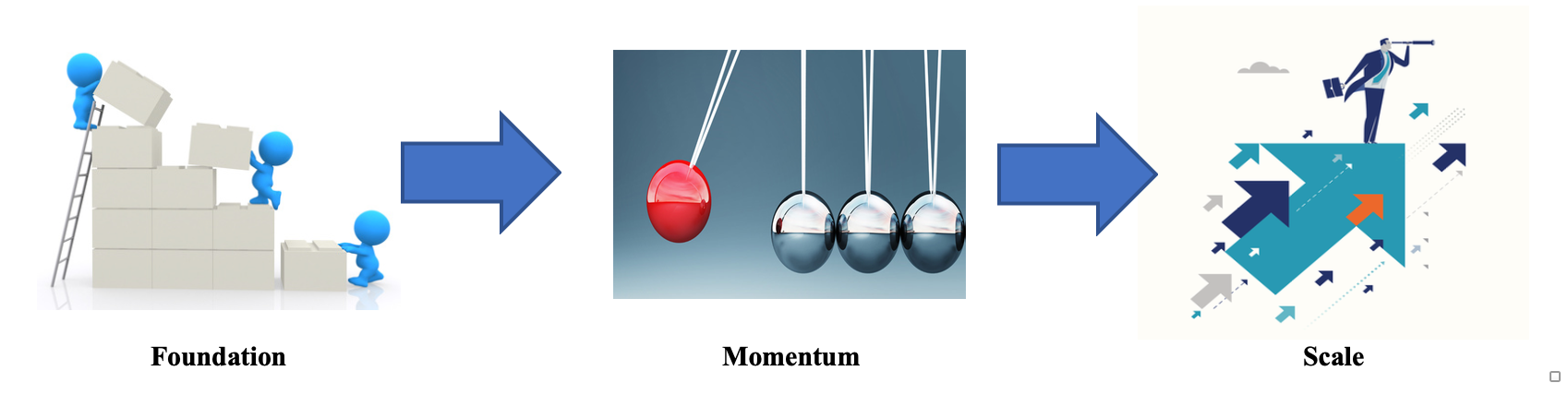
Stage 1: Build a Strong Foundation
Gain Clarity and Focus and then figure out what the market wants and how to sell it
This is an often overlooked stage that business owners and CEOs miss to their own detriment.
In one of our early businesses, we worked with an educator whose thesis was that if you teach students how to learn then you will have to spend less effort on teaching the actual subjects to the student as he will know how to learn himself. It sounded very good in theory and he had a number of success stories to show for his efforts. He wanted to start a school to deliver this methodology to a larger group of students and approached us to fund this expansion. After some research into the sector we decided to proceed with the investment, understanding that the objective was to get as many students enrolled as quickly as possible. 6 months into the venture it became apparent that the entrepreneur could not deliver and we pulled the plug on the business. From the very start we made several mistakes, firstly the entrepreneur himself did not have the required focus as he was beset with personal issues, something we missed in the due diligence process. Secondly, his assumption that such a system would be in demand was wrong. Parents want results and despite the clear benefits of his system, the impact is indirect and the results were difficult to prove. As a result, he was unable to sell the program at scale and the business soon ran out of cash. Pumping more money into the business would not have solved any of these underlying problems so the plug was pulled. A painful lesson for all of us at The Business Collective as our first foray into the education sector had failed. The entrepreneur here had neither the clarity on what the market wanted nor the focus required on sales and marketing to make the business work.
The first stage of any business involves a series of steps in preparing the entrepreneur and his team for success. This is a priming stage and this is where we gain Clarity on why we are embarking on a particular path and on where the path should lead. Then we must Focus on the right activities to move along the path. We look at businesses in Horizons and dedicate the majority of our time on what we deem Horizon 1 businesses or businesses that can bring in revenue today. Within these businesses, we focus on Sales, Marketing and Fulfillment. It’s important in this phase to focus on your strengths and outsource/delegate the rest. We must also quickly transition from planning to Action and test the business model and delivery mechanism and iterate the process till we are sure of what the market wants and we know how to deliver it to them.
Stage 2: Gain Momentum
Earn the right to grow
Once we know what the market wants and we know how to deliver it to them, we can start focusing on building momentum in the business. It’s here that you work on your branding and double down on marketing and refine your sales process. Too often companies jump to this stage without having the proper foundation in place and spend money on branding, marketing and sales without knowing what works and what doesn’t and inevitably end up burning cash without getting results. We also call this the Attract-Engage-Convert (AEC) process. Doing this properly is analogous to building up a fuel reserve which you can use to propel your growth during the next stage which is the Scaling stage.
Stage 3: Scale Exponentially
Structure and Innovate to stay ahead of the game
Up to now, we are focusing on what we have termed Horizon 1 businesses or businesses that give us revenue today. We have laid a strong foundation and know what the market wants and how to deliver it and then spent on building a strong brand with targeted marketing and efficient sales. We have now earned the right to grow and can now look at diversification. Too often entrepreneurs jump to this stage too early in their evolution and diversify too quickly. This leads to a dilution of focus that more often than not leads to failure.
When we structure the business we look to building profit centers as far as possible, not cost centers. I will explain this in detail in a later post but for now, just take this to mean that instead of a marketing department which incurs cost we outsource all marketing activities to a marketing company that runs its own P&L. The same applies to Branding, Admin, IT, Sales and other departments that you would see in a traditional corporate structure. This is a structure that we employ in The Business Collective. In this process we break the employee mindset, something I view as critical to the success of every entrepreneurial endeavor, leaving the CEO to become the conductor of a finely tuned orchestra on its way to becoming a high performing business.
The focus then shifts to establishing systems and processes and automating as much as possible while fomenting a strong team with the right partners and implementing an innovation process to stay ahead of the competition and evolving to stay relevant.

Figure 1: 3 Stages to a High Performing Business
In the next few posts we will start going into each of these 3 stages in more detail. I will also delve a bit into the process we went through in developing this methodology. Stay tuned!


0 Comments